
THE CUT- Amul
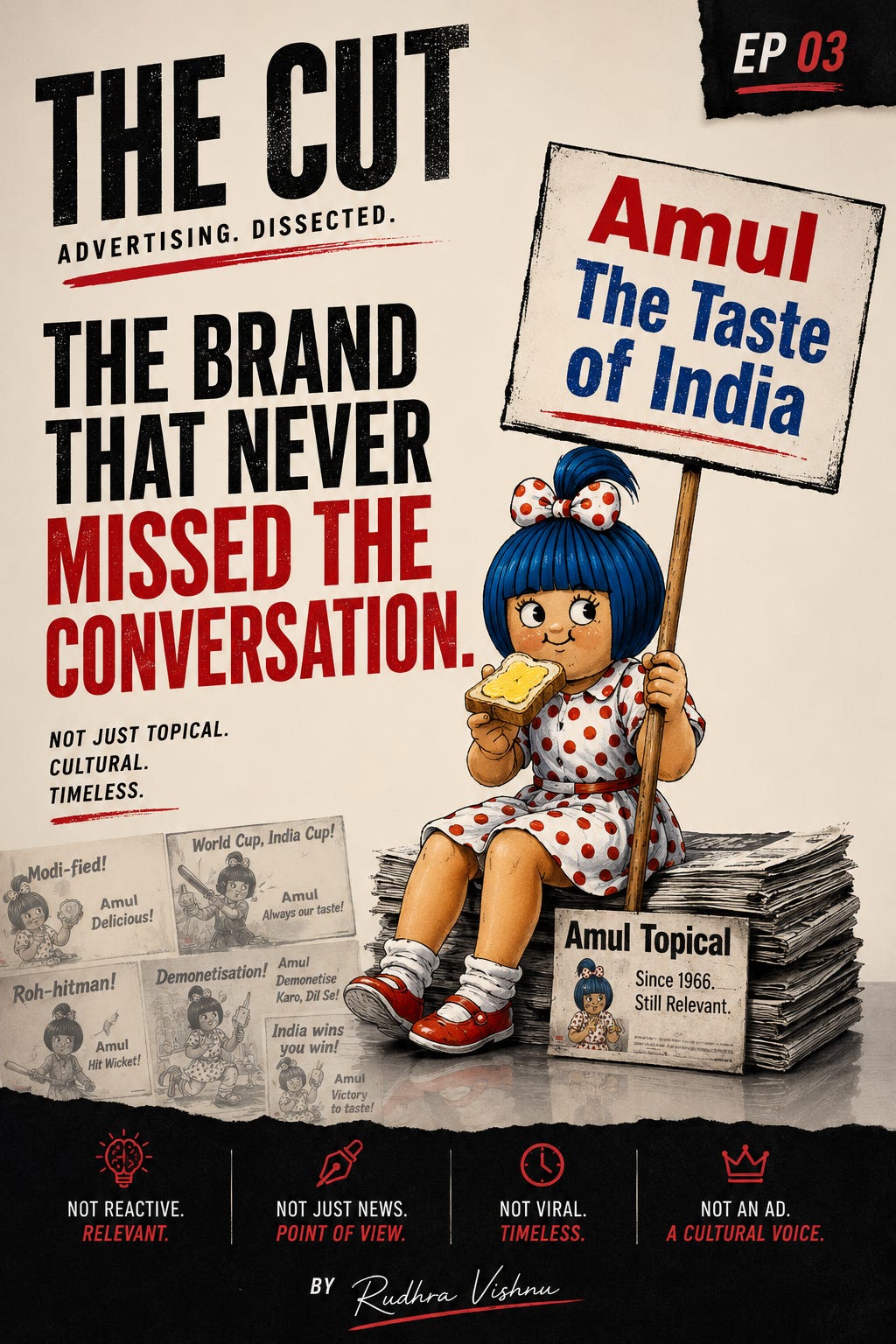
The Brand That Never Missed The Conversation

Every Monday morning, India waits for headlines.
For nearly sixty years...
It also waited for Amul.
One cartoon.
One pun.
One opinion.
No hashtags.
No influencers.
No performance marketing.
Just a billboard.
Somehow...
That billboard became more relevant than most brands with billion-rupee digital budgets.
How?
The Myth
Everyone says
“Topical marketing is about speed.”
Wrong.
It’s about judgment.
Speed without judgment creates noise.
Judgment creates memory.
The Hidden Strategy
Amul never tried to go viral.
It tried to stay relevant.
Virality lasts a weekend.
Relevance lasts generations.
That’s why children who grew up in the ‘80s...
Parents today...
And Gen Z scrolling Instagram...
All understand an Amul topical.
Very few campaigns survive three generations.
Amul did.
What Everyone Saw
Funny headlines.
Political jokes.
Movie references.
Cricket.
Bollywood.
Elections.
What Actually Happened
Amul quietly became India’s unofficial newspaper.
Not because it reported news.
Because it interpreted it.
That’s a massive distinction.
Journalists tell you what happened.
Artists tell you what it means.
Amul did both.
The Lesson
Most brands ask,
“What should we post today?”
Amul asked,
“What deserves to become part of culture?”
Those are very different questions.
Director’s Notes
Every visual contains one unmistakable hero.
One joke.
One visual metaphor.
One headline.
Zero clutter.
Maximum recall.
Notice what’s missing.
Nothing is explained.
The audience is trusted to complete the joke.
Great advertising respects intelligence.
The Edit Room
If I were directing Amul today...
I wouldn’t touch the illustration.
I wouldn’t modernize the typography.
I wouldn’t redesign the mascot.
I’d only change one thing.
I’d document the thinking behind every topical.
Imagine an archive explaining why each piece worked.
It would become the greatest advertising classroom in India.
Final Cut
Most brands chase attention.
Amul earned anticipation.
There’s a difference.
Attention is bought.
Anticipation is built.
And that’s why, after six decades, a small girl in a polka-dot dress is still one of the sharpest commentators in Indian advertising.